



Substack shipped an AI detector this week. Any reader can scan a post published from July 21 onward and get a percentage back.
Mine came back at 70%. That’s about right. I draft roughly half of what you read here with a model in the room; English is my second language, and Grammarly has been rewriting my sentences for years.
And I’ve run Grammarly on everything for years. Not just commas. It rewrites sentences, and I accept the rewrite when it’s better than mine, which for someone writing in a second language is often. Every one of those accepted suggestions makes my prose smoother and more predictable, which is exactly what a detector reads as machine-made.
What the number actually measures
It measures whether a machine touched the words.
It can’t see that I sat with my ideas for three weeks and threw out the first four versions. It doesn’t know whether I ran my framework on my own brand before asking you to run it on yours, or whether the position in that article cost me a client.
I almost broke my own rules
The first thing I did after seeing the number was look up how to lower it. Took twenty minutes to find the method, and it isn't complicated.
Write longer sentences that lose the thread halfway. Add redundancy. Let a paragraph wander before it gets to the point. Sound less sure. Reach for a different word when the right one already showed up twice.
Read that list again. Every technique for scoring as human is a technique for writing worse. Predictability reads as machine-made, so the way to look human is to be less clear, less sure, less disciplined. The score rewards the exact habits you've spent years training out of yourself.
And I sat here this morning, in a draft, seriously considering it. Ten articles into a series about not letting an algorithm decide what your voice sounds like, and my first instinct when a new scoreboard appeared was to start performing for it.
Fuck that. It’s the same treadmill.
Post daily because the platform rewards it. Sand your edges off because “warm and professional” tests well. Break your own sentences on purpose so a machine likes you more.
Different scoreboard, identical trade: you hand over the thing that makes your writing recognizable for a metric nobody asked you to hit.
I’ve been telling you to refuse that deal since the first article. Turns out it’s easy to say when it’s someone else’s number on the screen.
So the scan is off, not to hide the result; you just read it.
Substack lets you write a statement about how you make your work. Mine says I write with AI, that English is my second language, that the ideas and positions are mine, and that I rewrite hard before anything goes out.
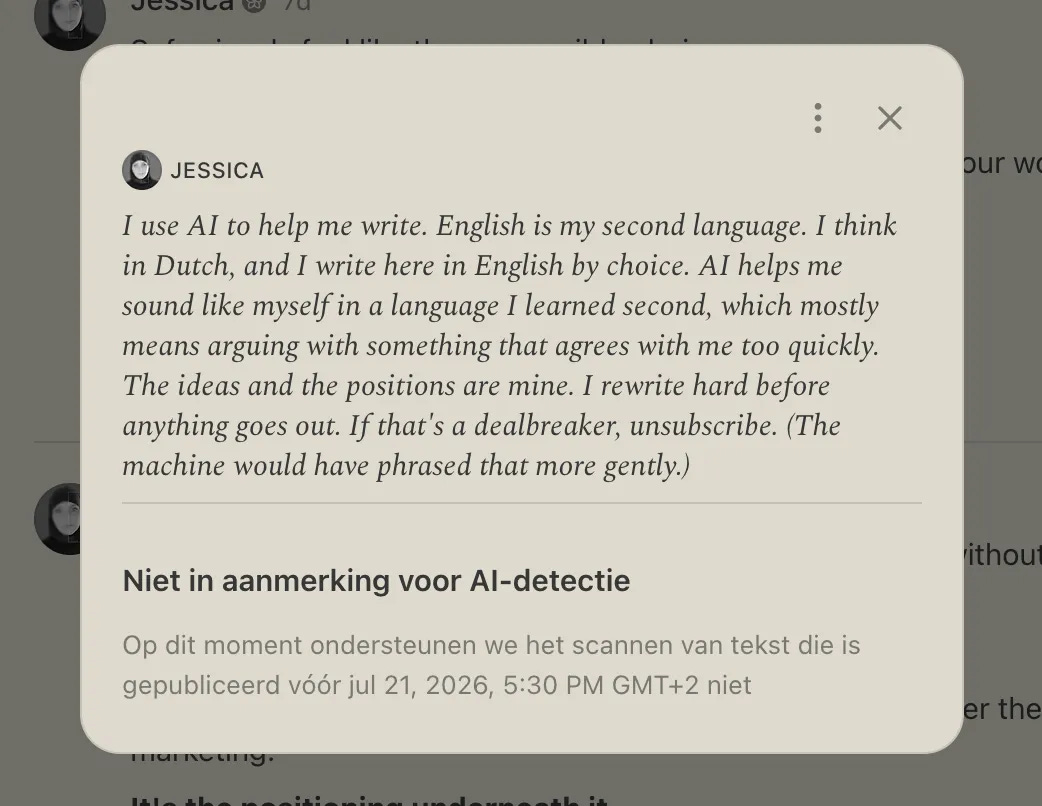
That last line is the only one you can actually test. So test it.
Read six of these and decide whether there’s a mind behind them or just fluent output. You’ll know within two. Readers could always tell the difference between someone thinking in public and someone filling space, decades before anyone shipped a tool for it.
Most people are going to quietly switch this feature off and say nothing. A few will write a statement that’s technically true and carefully vague.
Write the real one instead. Say the number.
Judge me on whether the ideas hold. That’s the part I can defend.
So here’s where I land. I’ll keep writing with AI. The score can land wherever it lands. I’ll keep throwing out most of what it gives me. And I’m not loosening a single sentence to move a number.
Neither should you.
See you in the next,

This is the best thing I've read all day! What a cool, gutsy article about this stupid, mindless, machine model approach to deciding whether or not a piece of writing is real or artificial.
Good work, keep it up. Fuck the machines.
How do we know if the AI detector is even real or accurate? And if you aren’t using AI to write online, well goood luck then!